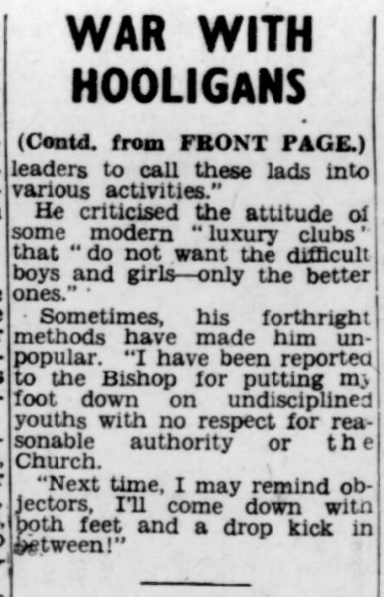
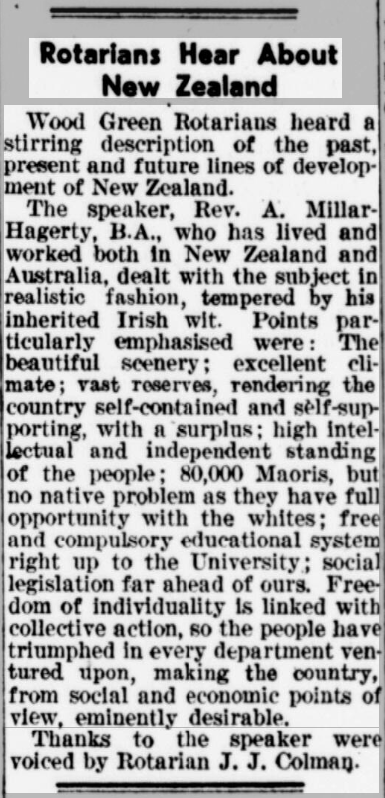
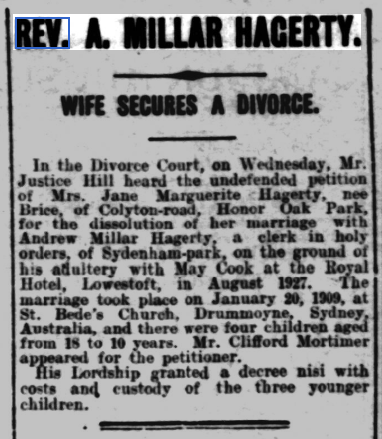
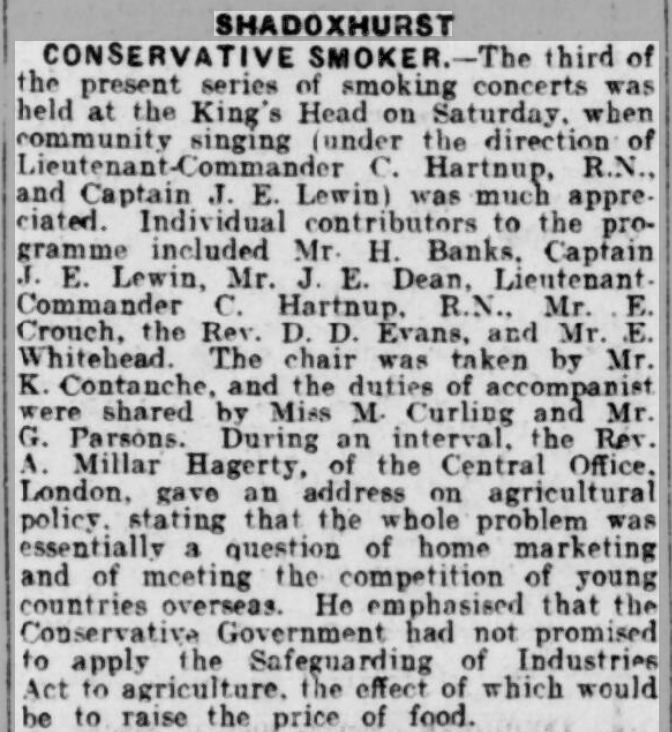
[AWH. St Peters ended up as a storeroom for relics of old, bombed churches. Was thje vicarage also a storing place for stray vicars?
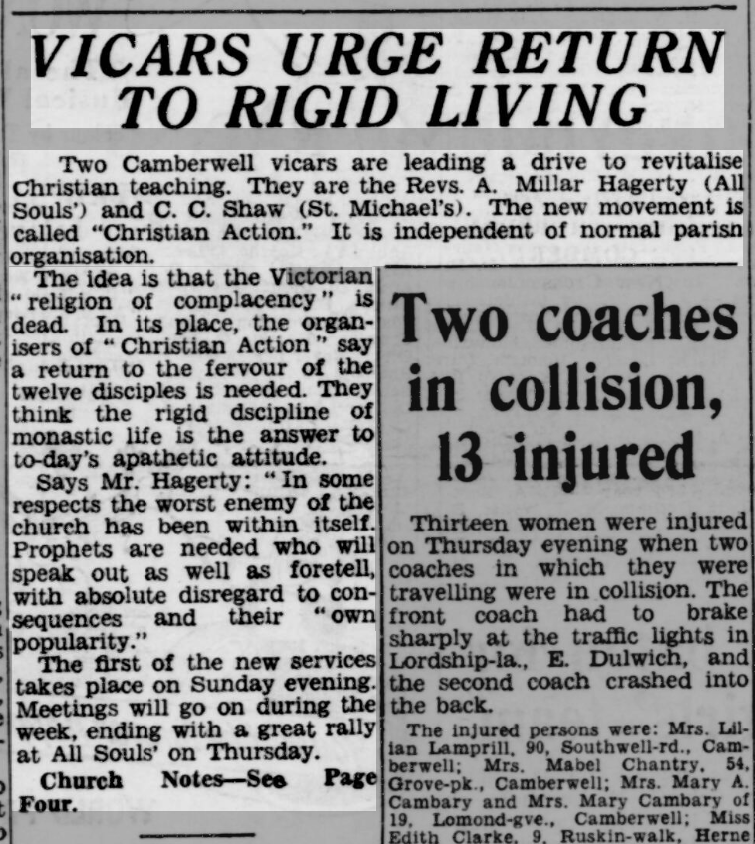
He was a man of grand, vaguely defined gestures and appeals – calls to action – rigid living]
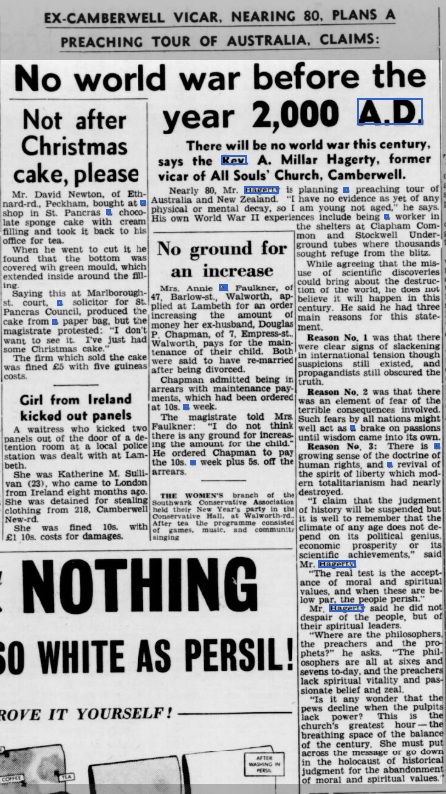
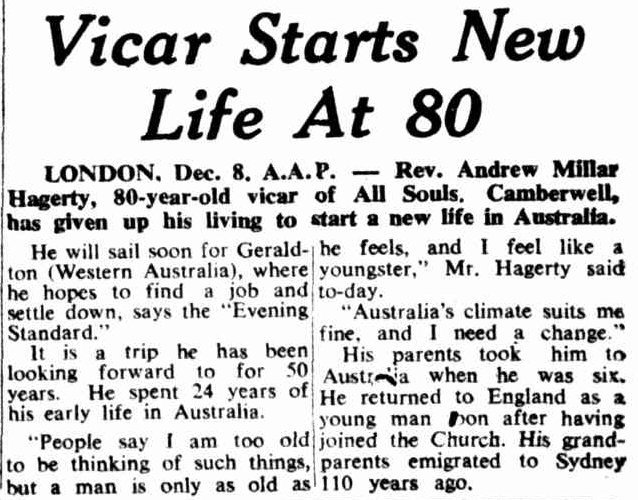
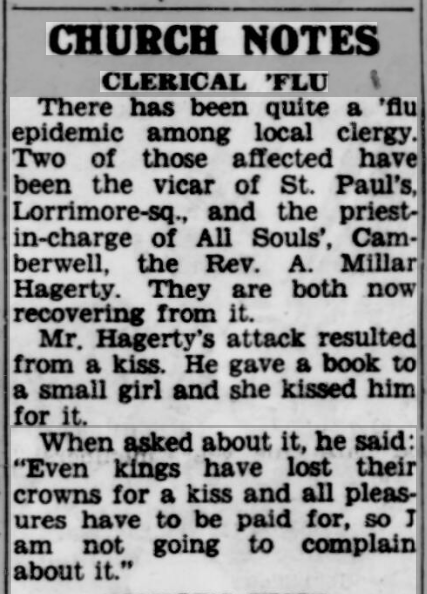
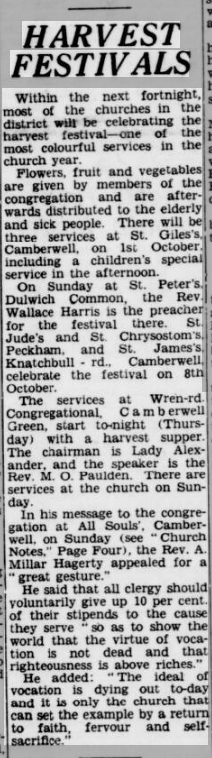
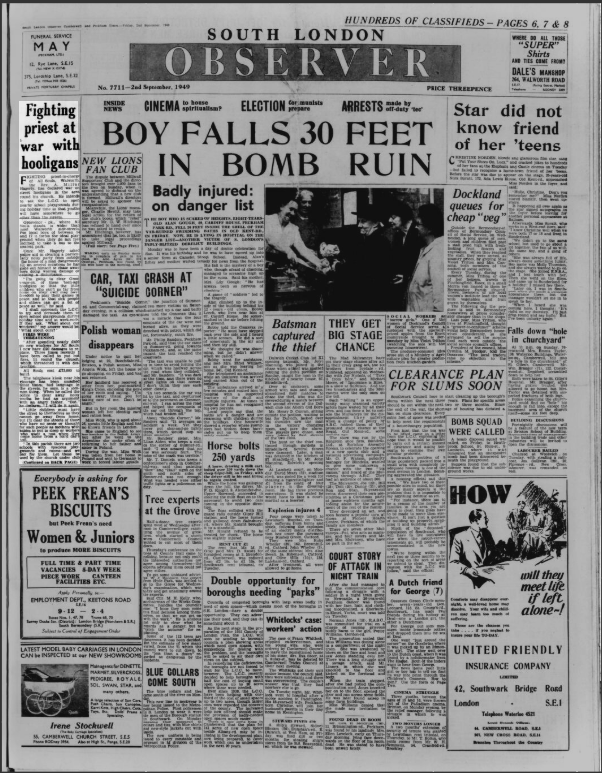
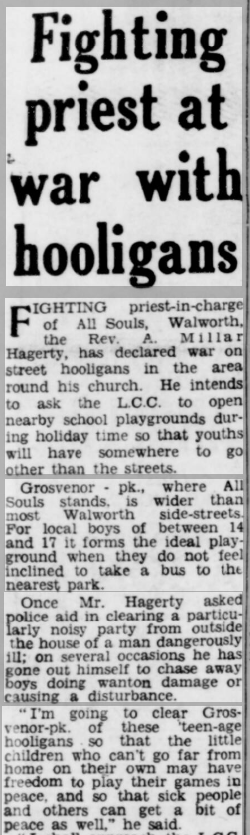
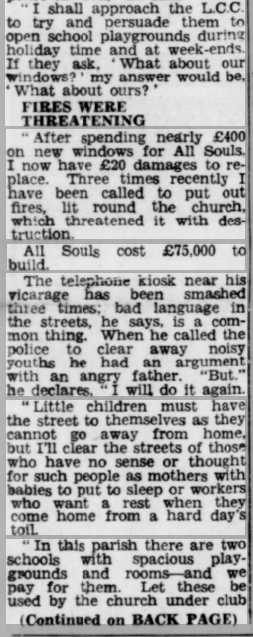
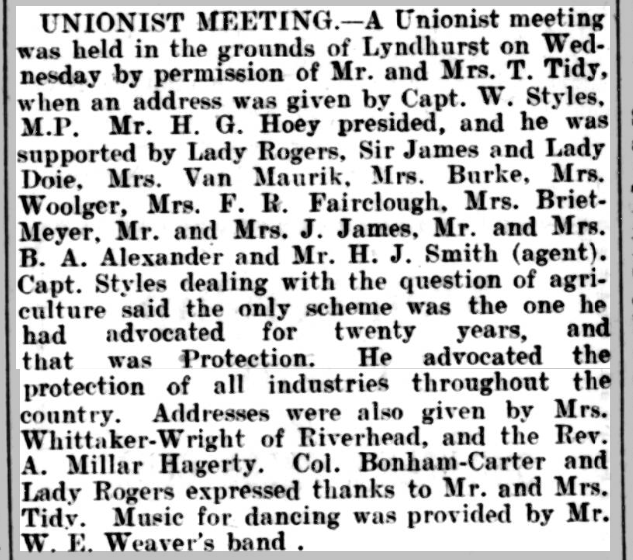
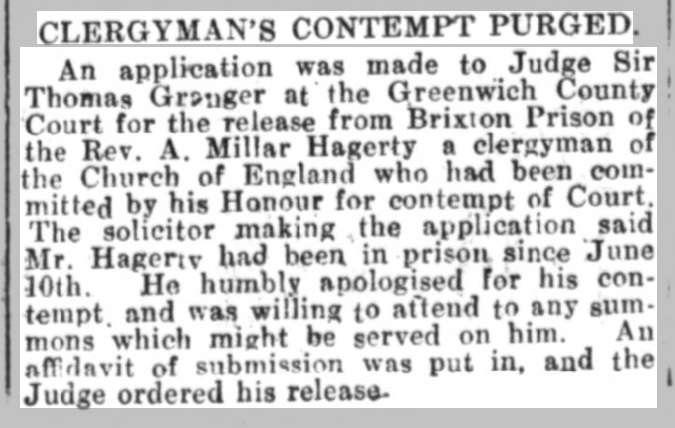
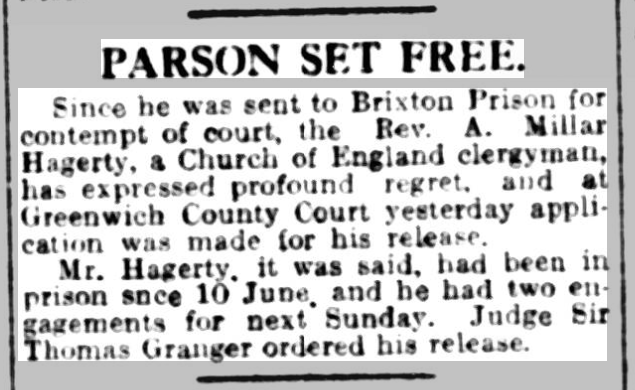
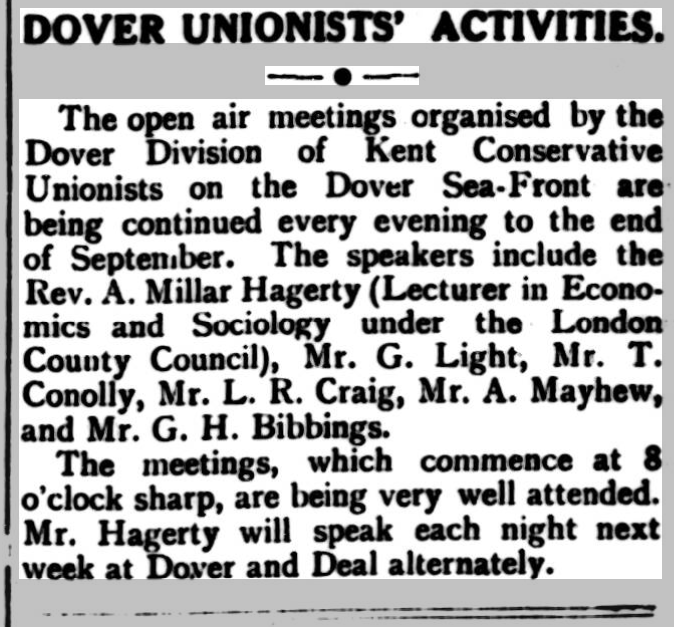
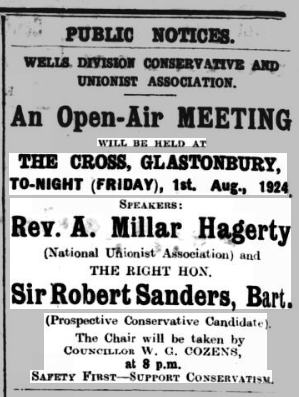
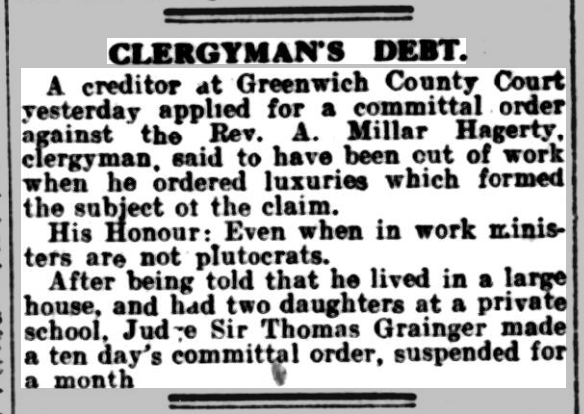
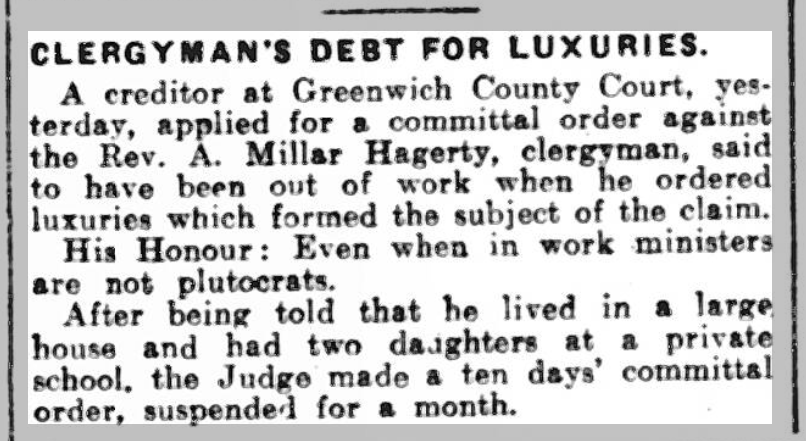
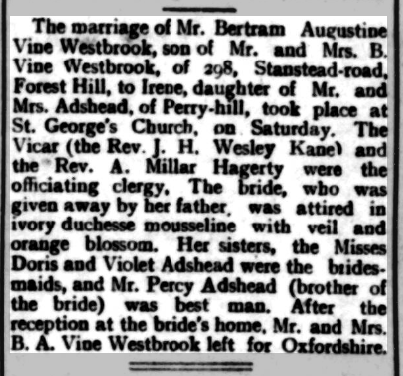
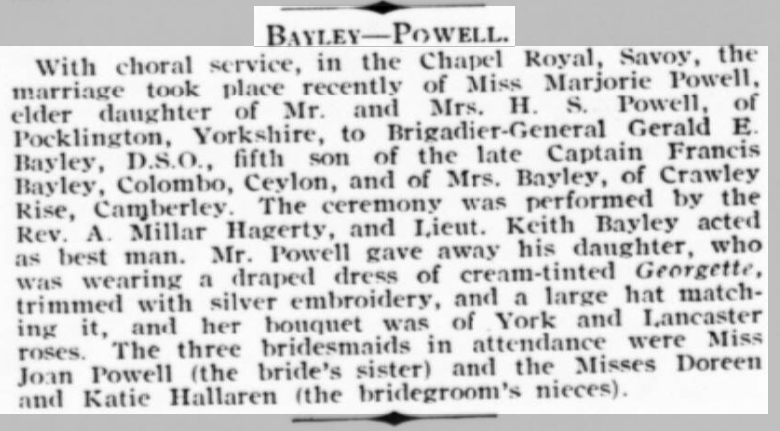
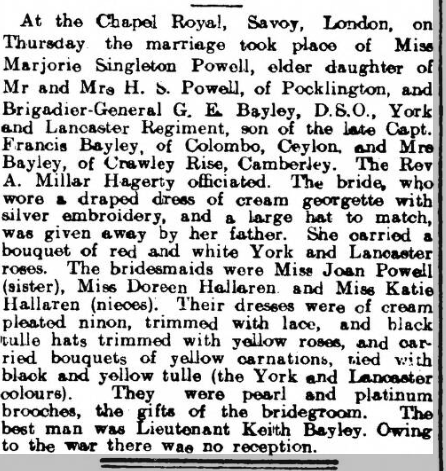
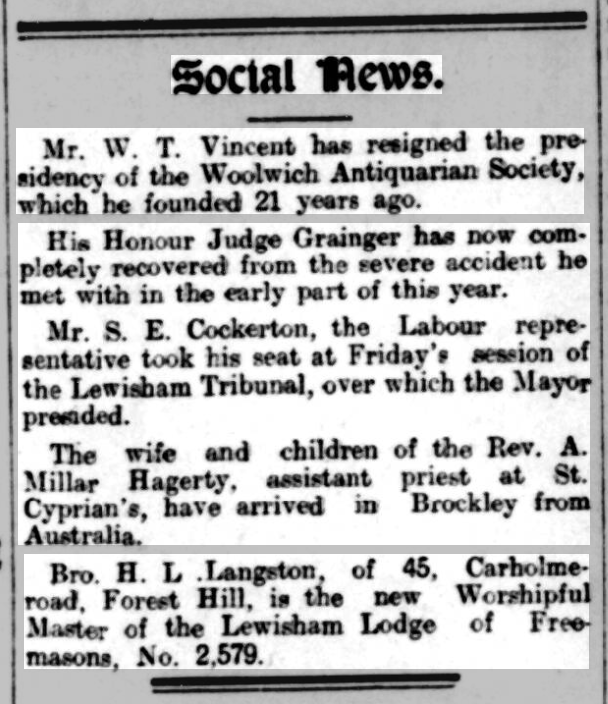
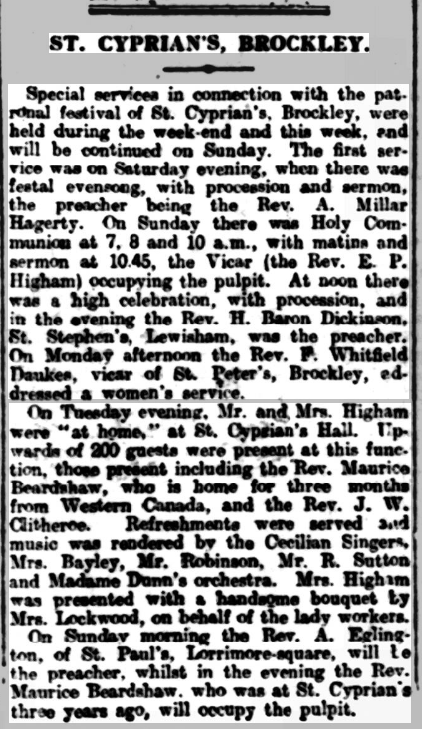
South London Observer – Thursday 14 January 1954Newcastle Morning Herald and Miners’ Advocate (NSW) Wed 9 Dec 1953 Page 1South London Observer – Thursday 19 July 1951South London Observer – Thursday 01 March 1951South London Observer – Thursday 21 September 1950South London Observer – Friday 02 September 1949Wood Green and Southgate Weekly Herald – Friday 25 May 1945Sydenham, Forest Hill & Penge Gazette – Friday 20 April 1928Kentish Express – Saturday 10 December 1927Westerham Herald – Saturday 16 July 1927Gloucester Citizen – Monday 22 June 1925Daily Express – Saturday 20 June 1925Westminster Gazette – Saturday 20 June 1925Dover Chronicle – Saturday 30 August 1924Central Somerset Gazette – Friday 01 August 1924Daily News (London) – Saturday 24 May 1924Lancashire Evening Post – Saturday 24 May 1924Forest Hill & Sydenham Examiner – Friday 13 July 1923Lady’s Pictorial – Saturday 15 September 1917
[AWH – “Owing to the war there was no reception.”]
Hull Daily Mail – Saturday 25 August 1917Lewisham Borough News – Friday 20 October 1916West Kent Argus and Borough of Lewisham News – Friday 01 October 1915
In November 2024, London’s annual Mid-Century Modern fair celebrated its 21st anniversary in Christison Hall, a light, airy, wood and concrete ceremonial space in the grounds of Dulwich College. Here you could shop for Panton, Knoll or Eames chairs, World Expo posters or fabrics by Lucienne Day, and leaf through a range of zines, maps and books, while the building around you radiated optimism and repose. Among the books on sale were two about the architecture of postwar South-East London: Ana Francisco Sutherland’s Modern Buildings in Blackheath and Greenwich and the multi-authored Dulwich: Mid-Century Oasis. These books concentrate not on the familiar story of vast state-funded social projects, but on the mid-20th century as a period in which middle-class modernist housing was built on a large scale in places like the inner suburbs of South London. It was housing you might not be able to afford yourself, but which you could take as a model when furnishing your own more mundane home.
Every era creates its own syncretic architectural history. ‘Palladian’ was an 18th-century codification of Palladio for English use; the Victorians popularised such terms as ‘Early English’ and ‘Perpendicular’ to define distinctions between types of medieval architecture; in the late 1960s, the critic Bevis Hillier invented the term ‘Art Deco’ for the commercial architecture of the 1930s – it was used by nobody in that decade. Mid-Century Modern would have been called ‘Contemporary’ when used of commercial work, the ‘International Style’ in its luxury forms and ‘Brutalism’ at its avant-garde edge. Such terms tell us more about the period in which they are coined than the one they are defining. ‘Mid-Century Modern’ is an import from the US: it was the title of a book by Cara Greenberg about 1950s furniture, published in 1984. It became common currency when the high modernism of the 1940s to the 1970s met the 21st-century market in period property, furniture and antiques. It is a dealer’s term, an estate agent’s term, a restyling of what once seemed dowdy or worthy as nostalgically glamorous: a middle-class modernism extracted from uncomfortable associations with social projects, welfarism and public housing. Its appeal is bound up with its accessibility, via mass-produced goods, furniture in particular. Most of us will never be able to live somewhere built by Le Corbusier or Mies, or own an original piece of furniture by Eileen Gray or Marcel Breuer. But rummage around on eBay or visit a Mid-Century Modern fair, and you can buy an Ercol dresser, a Panton chair or a set of Eames coat hooks (I own these last two items myself).
The part of London most closely identified with the high modernism of the interwar years, as introduced by émigrés from fascist Germany, is inner North-West London: the borough of Camden, and to a lesser extent Westminster, Barnet and Brent, with Hampstead and Highgate at the epicentre. It is here that you can find the major buildings of Berthold Lubetkin and Tecton, the houses of Connell, Ward and Lucas, Maxwell Fry or Ernst Freud, and utopian one-offs such as Wells Coates’s Isokon building. It was also in Camden in the late 1960s and early 1970s that this white-walled, abstract, often low-rise high modernism was emulated in social housing, in extraordinary projects such as Alexandra Road or Highgate New Town. This was the first part of the capital – and the country in general – to open itself up to the new architectural ideas that had emerged by the mid-1920s out of Berlin, Prague, Vienna and Moscow.
If the more demotic, more commercial world of Mid-Century Modern has a London home, it is in the South-East of the city, the once industrial inner suburbs of the low-density, largely Tubeless boroughs of Greenwich, Lewisham, Southwark and Lambeth – and especially the ‘villages’ of Dulwich and Blackheath. The differences from Camden are immediately visible. The white walls, fair-faced concrete, minimalism, abstraction and strongly urban space of NW1 are replaced by the weatherboarding and tile-hanging, stock brick, rolling hills, sycamores and pines of SE25.
It’s often said that architects would never have deigned to live in the modern flat-roofed houses or tower blocks they designed for council tenants. These two books are a reminder that architects do usually test their ideas on themselves first. Peter Moro, who worked for Lubetkin’s practice and designed the Royal Festival Hall’s interiors, was introduced to Greenwich and Blackheath after the war by a pupil, the architect and local resident Trevor Dannatt. Moro was so impressed that he moved to a house of his own design in the secluded Blackheath Park. ‘I went to Greenwich and I was absolutely charmed by it,’ he recalled. ‘I thought, what a wonderful place that was. It had everything. And there was Blackheath Village … there was the [Morden] College, there was the park, there was history, there was sort of social cohesion, beautiful buildings.’
The list of major buildings in Greenwich and Blackheath is formidable – Wren, Hawksmoor and Vanbrugh’s Royal Naval College, Hawksmoor’s St Alfege, Inigo Jones’s Queen’s House, the ‘castle’ that Vanbrugh built for himself, the Georgian crescent of Michael Searles’s Paragon – and while Dulwich is less monumental, it does have John Soane’s Picture Gallery and the buildings of Dulwich College, ranging from mannered Georgian to Barry’s lurid neo-Gothic, with the remnants of the Crystal Palace nearby and the bizarre tower of Charles Townsend’s Horniman Museum overlooking it all. Both zones are arranged around large open public spaces: the tended royal park at Greenwich and the wilder expanse of Blackheath (where Wat Tyler assembled insurgents for the Peasants’ Revolt in 1381). A few miles south and west are Dulwich Woods, Sydenham Woods and Dulwich Park, ‘leafy’ areas in a part of London that could be otherwise defined by less sylvan spots: Walworth, Woolwich, New Cross.
Both these books are almost wholly about housing, with a handful of public buildings thrown in, and both feature a mix of new and archival photographs, plans and drawings, and testimonials from current residents, though the Blackheath and Greenwich volume has more personality and better stories, reflecting the more unusual Mid-Century Modern housing to be found there. The aesthetic of the interiors shown is remarkably similar in both books, with endless white or bare brick walls, hardwood staircases, often gently curved or cantilevered, objets trouvés, sunken levels and mezzanines, and light, light, light. There is curiously little difference between the archival and recent photographs, sometimes even in the dress and hairstyles of the residents.
In his foreword to Modern Buildings in Blackheath and Greenwich, Neil Bingham ascribes the unusually large proportion of private modern housing to a well of ‘middle-class radical idealism’ shared with Hampstead and Highgate. Francisco Sutherland quotes the son of Walter Greaves, one of the area’s leading architects, on what it was like growing up there in the 1960s: ‘In retrospect I realised that my parents were very progressive compared to my friends’ parents, and I was surrounded by modernism and fascinating people.’ These fascinating people liked to live near one another. The book includes a map compiled by the South London Society of Architects in the 1970s which shows an enormous concentration of members in the Blackheath area – 97 of them – and smaller but still substantial numbers in Dulwich, Sydenham and Forest Hill. There were only three architects in Peckham, and none in Rotherhithe. This is, then, an index of middle-class London before the gentrification of the industrial areas nearer the river. The society’s explanation of the numbers was straightforward. Between the 1950s and the 1970s, before the great revaluation of Victoriana, architects were mainly interested in two things: the modern housing of the private developer Span and Georgian housing. Blackheath had plenty of both, and Dulwich was being filled with superior Span imitations.
The books discuss two very different development projects. The examples in Greenwich and Blackheath are far more diverse than in Dulwich – 64 houses/estates and 38 different architects – but in a much tighter geographical area, and completed between the 1950s and 1980s; many of the residents will have known the architects of their houses. The Dulwich projects consist of 31 estates, sprawling across the hills, comprising two thousand properties built between 1957 and 1978 for one client (the Dulwich Estate) and one developer (Wates, one of the biggest at the time), by one firm of architects (Austin Vernon & Partners). This was superior suburban housing, while the new houses in Greenwich and Blackheath appear to have been hipper and more rarefied. Rock musicians were moving there in the late 1960s, along with architects, academics, Labour politicians, and radio and TV presenters.
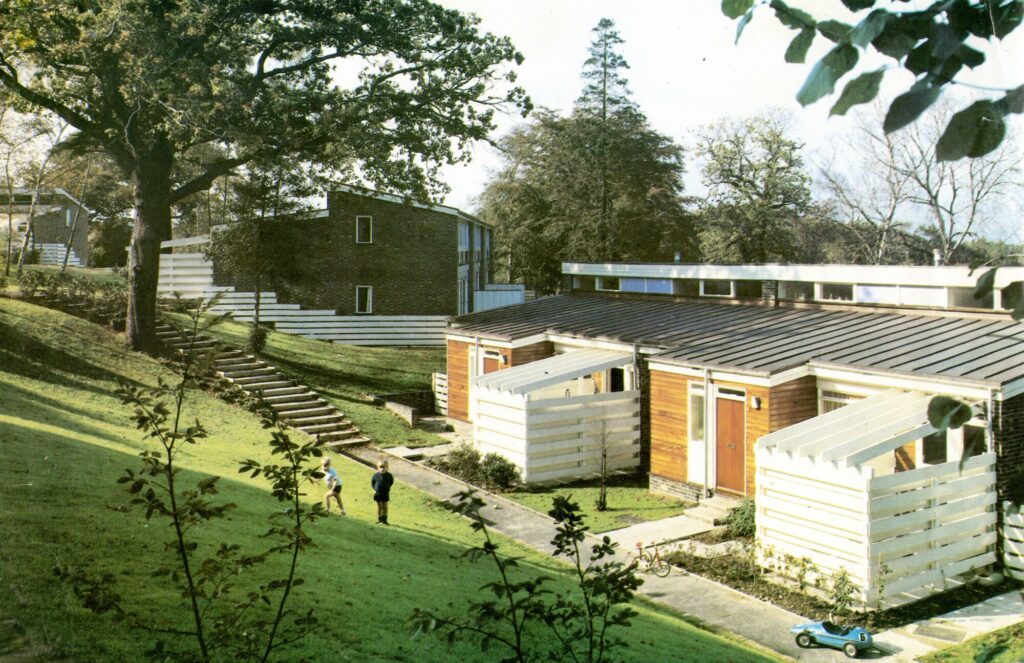
Peckarmans Wood, designed by Malcolm Pringle of Austin Vernon & Partners, on completion in 1966.
The housing in Blackheath and Greenwich isn’t revolutionary, but it is attractive, and sometimes engages in an obvious way with the Georgian housing that was the other choice for the 1960s intelligentsia: the stepped terraces of Rangers Square, for example, by Andrews, Emmerson and Sherlock, resemble abstracted Georgian houses denuded of servants’ basements and the strong verticality of the classical tradition. Brick and wood are far more common than raw concrete or steel, and the brick is sometimes ingeniously used, as in the curved garden walls of E. Morton Wright’s Morden Road Mews, which loop round the tiny houses. Francisco Sutherland documents some striking landscape effects around the heath. One photograph shows its wildest corner framing the concrete grid of Arthur Rubinstein’s low-rise block of flats on Vanbrugh Park: an almost 18th-century image of nature and geometrical rigour. The Dulwich work uses landscape in a much more controlled way, with fewer ‘English’ effects, as in the tall evergreen trees and bounding lawns of the Peckarmans Wood estate in Sydenham.
The glass, coloured panels, wood and tile-hanging in the Dulwich projects are modelled on Span’s work in Blackheath, but there is a greater diversity of types, ranging from the small pitched-roofed houses at Oakfield Gardens to some daring private high-rises, which were very unusual until the 21st century. The best development, as is so often the case, was the first, the Dulwich Wood Park Estate, with its small houses and eight-storey tower blocks, beautifully detailed with coloured panels, enormous windows and concrete pergolas. This was mildly experimental for developer housing, but compared to Park Hill, Balfron Tower or Keeling House, it was very tentative, an essay in what Wates described in its publicity as ‘the modern contemporary style’.
Wates advertised its Dulwich homes in the newspapers, in particular those read by the professional demographic it was targeting: the Sunday Times and the Observer. By contrast, a lot of the housing discussed in Modern Buildings in Blackheath and Greenwich was commissioned directly by the residents, or built by architects for themselves. It is extraordinary now to imagine so many architects being able to buy patches of inner London land to build on. In Greenwich and, especially, Blackheath, the list of architects’ self-designed houses is long: Peter Moro, Brian Meeking, David Branch (whose elegant, Miesian case study-style house has now been demolished), Leo Rubinstein, Paul Tvrtkovic, Ray Smith and Ronald Coleman. Most of these were deadpan little houses, in brick with exposed concrete frames, often with small windows onto the street and much larger ones onto the gardens and courtyards.
Clients included playwrights (Michael Frayn), pop stars (Sandie Shaw), TV presenters (Janet Street-Porter) and typographers (Ruari McLean developed a small modernist house on a gap site next to his Georgian pile in Blackheath Park). A Czech wine merchant paid for his house wholly in wine. The future prime minister James Callaghan commissioned a modernist house on Montpelier Row from Ursula and Gordon Bowyer (Ursula, who died this year at 99, was like Moro a German Jewish émigré), residents of nearby Maze Hill. The project involved two connected houses, one of which was sold, and one of which was occupied by Callaghan and his family from 1958. It is stark, unpretentious modernism, but James and Audrey Callaghan were very unhappy to leave it for Downing Street when he became chancellor in 1964; it had, Audrey said, become ‘like a second skin’ – designed wholly around their needs and wants. In other cases, client, architect and developer melded into one, as at Rocque Lane, a short street developed – and named, after the 18th-century London cartographer John Rocque – by the architects John Roberts and Walter Greaves. The architecture here is especially laconic, and if there’s something that marks it out from the public housing of the time, it’s the desire to fade into the Georgian background while remaining clearly modern, a having-and-eating of cake that can be found in other buildings of the time, such as Kettle’s Yard in Cambridge.
There are two outliers – one aesthetic, one social – among these private housing projects. No. 10 Blackheath Park, designed by Patrick Gwynne, is an outré, glamorous house, with a fetishistic black slate and black-tinted glass exterior, an imposing symmetrical plan and ostentatiously synthetic materials within – the walls are lined with ‘plastic cloth’, a material, as Francisco Sutherland notes, usually used for the interior of aeroplanes. The social outlier is North Several (‘Several’ is the name for private land adjacent to a common), a self-build scheme of 1968 led by the architect Royston Summers and a group of enthusiasts including Michael Frayn, who wrote about it, after its collapse, in the play The Benefactors (1984). It looks as simple and modest as all the other blocks here, but was a deliberate experiment in collective housing, its spaces and materials designed for and by an active group. It failed, for reasons which will be familiar to anyone who has read any novels of the 1970s set in this milieu (High-Rise, The Ice Age). Francisco Sutherland quotes one resident: ‘The most striking irony, it seems now, was the paradox between the spirit of openness that the vast glass windows seemed to suggest about the lives of the inhabitants, and the number of marital infidelities that began to emerge.’
Everything revolved around Span. Its chief designer, Eric Lyons, had worked for Walter Gropius during his brief spell in London. Span was a partnership between Lyons and the architect Geoffrey Townsend, the landscape architects Ivor Cunningham and Michael Brown, and the developer Leslie Bilsby, who commissioned 10 Blackheath Park. Span first became known for Parkleys, an estate in the outer South-West London suburb of Ham, where its architects displayed their distinctive style: flat roofs, huge windows, open plans, carefully maintained communal landscapes, and façades with weatherboarding or tile-hanging to leaven the Bauhausian abstraction. There are around a dozen Span estates in Blackheath. ‘If Eric Lyons is the modern Nash,’ Ian Nairn wrote, ‘then this is his Regent’s Park.’ The comparison also captures something of what distinguishes this housing from the dense, street-block structure of Nash’s plans for the Prince Regent. Like Nash’s work, Span housing is bright, lightweight and coherent. It is dense by the standards of suburbia; but it is suburban nonetheless, with the buildings facing inwards towards the landscaping, rather than outwards towards the passer-by. There are stylistic shifts in the two decades of Span estates built in Blackheath from the mid-1950s to the late 1970s – from the bright, crisp Mid-Century Modern of the Priory, to the concrete and dark brick of the quasi-Brutalist Hallgate, to the almost postmodernist Corner Green, with its high, symmetrical arrangement of windows – but it never returns to the 19th-century block.
Span’s architecture can look dowdy, conservative, even bland, if not augmented with the right furniture, the right signage, the right windows and, crucially, the right landscaping. As Francisco Sutherland notes, the owners of properties on Span estates are mandated to look after the façades and public spaces together, with the result that they have escaped the horrible securitisation – fences, gates, spikes, CCTV – common to modernist council housing. There is a cost, however, in the form of all the notices telling you you’re on private land and aren’t allowed in.
Span at its peak was a dominant influence on volume housebuilders. Its imitators – Bovis and Wates prominent among them – built most of the exurban housing in southern England before the rise of Barratt and the cul-de-sac neo-traditionalism of the 1980s. There is one example of developers’ housing in Modern Buildings in Blackheath and Greenwich: St Germans Place, by Wates’s in-house architect, Lorenzo Masini. Its clipped, articulated row of brick and glass is barely distinguishable from Span. Walk around the Dulwich Estate, though, which was redeveloped by Wates, and differences emerge. The work is better than the Wates average – there is even a certain amount of public art, with mosaics, murals and sculpture in the shared spaces – but it is considerably more American than Span. There is much less use of English forms like terraced houses and squares. The landscaping is flamboyant and formal, and the houses are often much more spaced out. The authors of Dulwich: Mid-Century Oasis note the ‘very open “Californian” feel’ of the Woodhall Estate, and that Wates planned for ‘low density and high car usage’.
These large-scale projects of modernist redevelopment, no matter how well mannered, met with significant opposition from conservationists. Blackheath Village and Dulwich Village were among the first conservation areas declared by the Greater London Council, in 1968. In Blackheath, modernists and preservationists – sometimes the same people – lobbied against the GLC’s plan for a ‘Ringway’ that would have carved through the area (the plan was dropped in 1972). Blackheath and Greenwich, with their more spectacular baroque and classical architecture, had conservation societies as early as the 1930s; the Dulwich Society was founded rather later, in 1963, in order to stop Wates building mass housing on the sites of 19th-century villas (here, as in most of South-East London, there was significant war damage, but Wates and Span were also knocking down sound housing).
Despite the superior quality of its houses, Span had severe difficulties getting planning permission for what became Hallgate. A neo-Georgian council estate at nearby Pond Road was more the sort of thing that local preservation societies liked (the Blackheath Society was ‘appalled’ by the much more sinister and space-age 10 Blackheath Park). This battle, which Span won after several years, is commemorated by Keith Godwin’s The Architect in Society, a sculpture set in the wall at the entrance to Hallgate which shows a body being crushed between concrete lintels – a hilarious image of architectural self-pity. Today, most of the Span estates are listed, and none of the Wates ones (yet).
In the mid-1950s, Anthony Crosland, Callaghan’s colleague on the progressive, pro-modernist Labour right, made some interesting comments in The Future of Socialism on the convergence, which Span represented so well, between council housing and private housing. Perhaps, if both were built to a similar aesthetic standard (elegantly modern, modestly spacious), there would be no need to nationalise large swathes of land or expropriate so many private houses. A reformed private housing industry and municipal socialism could march hand in hand. To a degree, this is what happened, as you can see when you compare the Span estates with the modernist council housing of Blackheath and Greenwich, which, apart from the since demolished Ferrier Estate in nearby Kidbrooke, was of a similarly high quality. This sort of parity has not survived into the 21st century.
The Wates estates in Dulwich weren’t just an alternative to council housing: they were planned specifically to stop council housing from being built on the Dulwich Estate’s land. As the authors of Dulwich: Mid-Century Oasis note, ‘it was Camberwell Council’s plans for compulsory purchase of much of the estate’s land for council housing that proved to be the major catalyst’ for development. After 1945, with a Labour government committed to building council housing for everyone and seeming at first to want to crush the property industry, the Metropolitan Borough of Camberwell informed the Dulwich Estate of the sites they intended to acquire, marked in red on a map of the estate’s holdings. A handful of these were acquired for small council estates, but in 1949 the estate proposed a counter-plan by Russell Vernon for mass private development. Labour lost the general election in 1951, the Tories returned to power under Churchill, and the new government was much more sympathetic to the estate, endorsing its plan over the local authority’s objections.
The best council housing in the Dulwich Estate isn’t modernist at all. The neoclassical Lammas Green, by McMorran and Whitby, is a cute ensemble with spectacular views to Croydon and Surrey beyond. The earliest big estate in Blackheath, Pond Road, was built for London County Council in the early 1950s by Albert Richardson, and it too is attractive, less for its staid neo-Georgian elevations than for the gentle way it spreads itself out around the greens and paths of Blackheath Park. Francisco Sutherland’s focus is on modernism, but she is dismissive of the era’s style wars, and baffled by Ivor Cunningham of Span’s scorn for Pond Road as ‘vapid Georgian flats for the masses’. (There was a better target nearby: on the other side of the heath is a private neo-Georgian estate of the same period, Parkside, which is stiff, pompous, boring, with a lawn in place of all the picturesque landscaping that makes this area such a fun place to walk around. It replaced some houses by John Vanbrugh.)
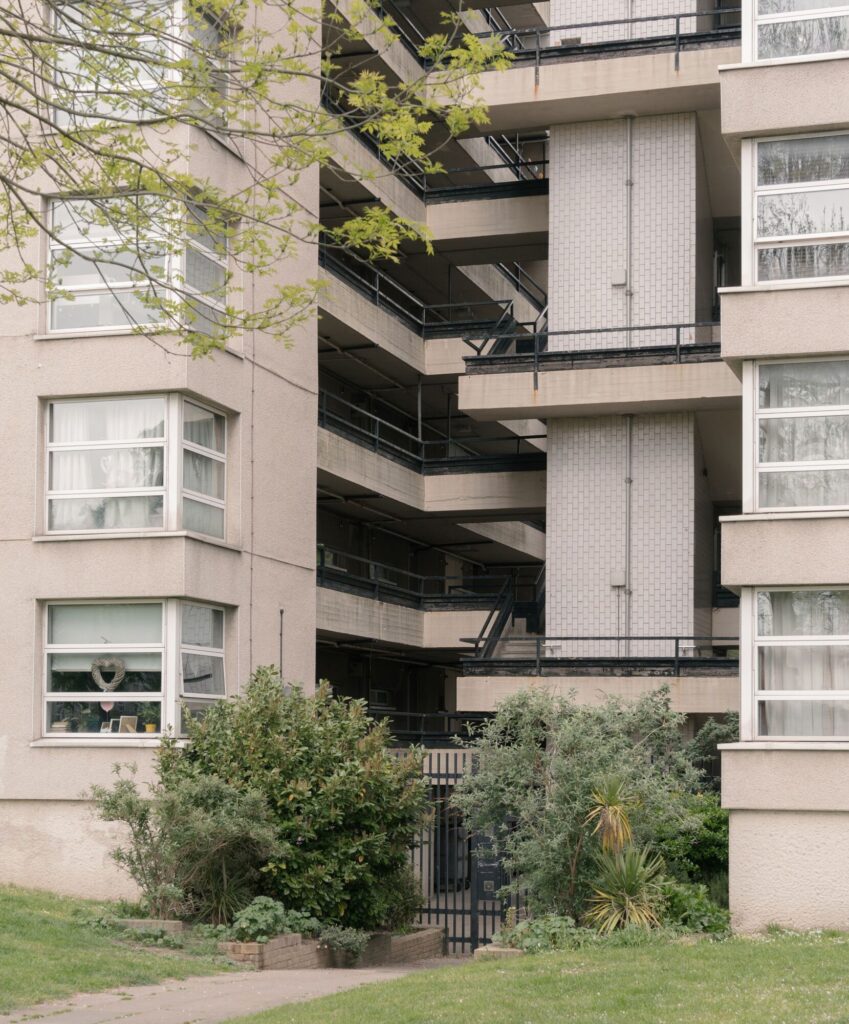
Vanbrugh Park Estate, designed by Chamberlin, Powell and Bon, in 1965.
The major council estate in Blackheath is Vanbrugh Park, by Chamberlin, Powell and Bon, the architects of Golden Lane, the Barbican and the University of Leeds. It is a step back from the pyrotechnics of these schemes, with only one tall tower – a sculptural, symmetrical block separated into two parts, with enormous studio-style windows for the top-floor flats. Trees and topography mean the tower is almost completely screened from the heath, but most of the estate consists of terraced houses in breezeblock around rather formal squares, deriving from the Georgian tradition in ethos if not in aesthetic. The homes are well planned and spacious, with luxuries like clerestory windows, but Right to Buy, strained council budgets and the usual misunderstandings over what is and isn’t intentional in the design of modern housing means that much of the original coherence has been lost, with differing façade treatments on the terraces and magnolia render on the tower. Residents and the council have both played a part in this, introducing pebbledash or plastic windows, but walk around the estate today and the underlying strength of the design is obvious. So too, as Francisco Sutherland notes, is the activism of the local residents’ association, which has led to a great deal of planting in public spaces, giving a more informal, and to my mind more attractive, sense of human beings living together than the manicured lawns and watchful eyes of so many Span courtyards.
On the other side of the heath, towards Kidbrooke, local resident Rosemary Stjernstedt designed Brooklands Park Estate for the LCC, and it has survived well: perhaps because it has a much simpler design, without Chamberlin, Powell and Bon’s Brutalist mannerisms. It is also much greener, closer to the modernised rus in urbe that Span and Wates were both trying to create. There are point blocks in brick around a lake, pitched-roofed and Scandinavian, with large balconies – much better in terms of space and amenity than the towers of the Dulwich Estate. There are also integrated artworks, as was common in the best LCC estates of the 1950s, ranging from a William Mitchell mural to Ganges, a sculpture originally made for the Great Exhibition of 1851 by Raffaele Monti. It hasn’t required a conservation plan drawn up by an architectural historian to keep Brooklands Park looking good. There was, I suspect, a tacit acknowledgment in Stjernstedt’s design that upkeep would probably be sparing, so everything that works here appears to have been chosen because it wouldn’t need much care: trees, brick, pathways, not so much glass, concrete or steel – no experiments.
Both Vanbrugh Park and Brooklands Park have fared better than two small estates by James Gowan, both on the flat land near the river, in areas that were then much more working class: Corvette Square, near the Royal Naval College, and Creek Road in nearby Deptford. Both have the sort of ingenious plan that architects tend to get excited about, with arrangements equally inspired by De Stijl housing in the Netherlands and the Italianate Powis Square in W11, all in red brick, organised around unambiguously urban asphalt squares. Like much of the private housing up the hill, Gowan’s estates have a very deadpan relation to the street, with small windows looking out over the traffic and larger windows facing the courtyards. But appraising any of this is difficult now, with the careful proportions completely destroyed by galumphing pitched roofs. Achieving the minimalist effects aimed at by so many of South-East London’s architects of the 1960s relied on a mutual understanding between client, architect and resident that by the 1980s had largely disappeared.
The fact that alterations, poor treatments and nasty additions are so common in council blocks – as compared to those built by Span, Wates or private clients – is very seldom a matter of building quality. (In fact, as Francisco Sutherland points out, Span houses are, if not shoddily built, usually somewhat flimsy, with thin walls, single glazing and shallow foundations, and very difficult to insulate.) The changes are a consequence of councils’ diminished resources, greater responsibilities – they are legally bound to insulate and make secure their buildings, and cheap plastic windows keep heating bills down – and something much harder to define but at least as significant, namely a declining architectural and aesthetic culture in local authorities. In the 1960s, most British architects worked for councils, and although they seldom lived in the council housing they designed, when they built for themselves they tended to create something similar. By the end of the 1980s, the squeeze on local authority funding and the abandonment of mass council housing had already begun to bring about the situation today, in which it is highly unusual for architects to work for councils. Municipal design expertise has evaporated.
None of this has stopped the young professionals who would once have lived in a Span house, or even bought some land and got an architect friend to design one for them, from moving into modernist council housing. It is, as estate agents are increasingly aware, often good housing, particularly in its use of space, light, storage and greenery. You can buy some secondhand Mid-Century Modern furniture, frame a few posters, put up a paper lantern or two, and your former council flat will begin to look much like something built by Span (I am again describing myself). One result is that estate agents are replacing the term ‘ex-local authority flat’ with ‘mid-century modernist flat by famous architect’; another more significant result is a genuine erasure of class differences in housing in much of London. Architects, designers, writers and media professionals are more likely to be living in (now former) council flats in South-East London than they ever were in the 1950s or 1960s. Even so, with the provision of new council housing at historic lows, those in need of it spend years on waiting lists for crumbs.
When the Ordnance Survey cartographers visited the area around Eltham Road, to the east of Lee Green, for the first time in 1863, a small number of large houses had been laid out at the edge of suburbia of Victorian London. The feel though would have been rural, little different to when horse racing had happened in the fields parallel to the main road and Quaggy up until the mid -1840s.
The change in the next four or five years was dramatic with new housing laid out along Eltham Road, almost up to what is now Sutcliffe Park. As the local MP remarked in 1870, ‘in a short period a town has sprung up in the neighbourhood.’ (1)
From around 1867, possibly slightly before, there was a temporary ‘iron church’ that was built somewhere in the area which was called St Peter, the exact location isn’t clear – a Rev. A Tien being appointed to minister from there from a church in Bedfordshire (2). As we have seen in relation to an iron church on what is now Baring Road (see above), ‘tin tabernacles,’ as they were often referred to, provided quick solutions to the provision of a church whilst funds were raised to build a permanent place of worship.
The foundation stone for the permanent church (pictured above) was laid on 3 December 1870 by Lady Louisa Mills, who was the wife of the local MP for West Kent, Charles Mills. He obviously wasn’t that impressed with his wife laying the foundation stone; his speech ‘regretting very much the absence of a member of the Royal Family’ (3). The Conservative Mills had previously lost his seat in Northallerton, amidst a bribery scandal. Also present at both the foundation stone laying and the service in the iron church that preceded it, were the Vicar Designate, the Rev J L Macdonald, along with the Vicars of Eltham and Greenwich (4).
The church was on the corner of what it now Lyme Farm Close and Courtlands Avenue, although it was just one street then referred to simply as The Avenue. There were a dozen or so large houses in the development plus perhaps another 150 large houses along Eltham Road, Cambridge Road (now Drive), along with Weigall, Osberton and Leyland Roads. It was an ambitious project for a small, albeit probably relatively wealthy and pious area. So, there was a range of fundraising activity to help pay including bazaars and concerts to help pay for the new church (5).
In the end, it all came together quite quickly with the new church consecrated in July 1871, just six months after the foundation stone was laid. The ceremony was undertaken by the Bishop of Colombo, in the absence of the Bishop of Rochester, most of local clergy in the area being present too. The church seemed large for the area – holding 750 and cost £4,500 to build (6).
The local paper, the Kentish Mercury, described it as ‘early French’ in style consisting of ‘nave, side aisles and an octagonal chancel…. surmounted by a very characteristic tower and spire…..Both externally and internally the edifice is of red brick, relieved with copious Bath stone dressings’ (7).
The architects were Newman and Billing, both called Arthur, who were based in Tooley Street and had an extensive practice mainly concerned with church work from around 1860. They were also acted as surveyors to Guy’s Hospital and to St Olave’s District Board of Works in Bermondsey. Other work included the design of the Grade II listed St Luke’s in Hackney and the Grade I listed Parish Church of St Dunstan and All Saints (The Church of the High Seas)
The builders were Dove Brothers who were a long standing Islington based builders operational between 1781 and 1993, well known for late Victorian church construction building around 130 churches between 1858 and 1900, mainly in London.
The church had parish rooms, a some distance away in St Peter’s Court at Lee Green, behind the New Tiger’s Head. The first mention in Kelly’s Directories was in 1894, but given the naming of the alley (which is still there) it probably dates from the 1880s or before. The last mention of the parish rooms was around 1911.
The church seems to have suffered as the wealthy suburban residents moved on and was closed in 1939 in a poor state of repair; several of the houses were empty on Courtlands Avenue when the 1939 Register was collected as war broke out, with others in multiple occupation – a parish probably unable to cope with the high running costs of the building. While no damage was marked on the London County Council Bomb Damage Maps (8) – given there were a couple of V-1s that fell on neighbouring fields it seem seems likely that there was some damage; certainly the church website suggests that. It seems that the remaining parishioners worshiped for a while at the elegantly situated St John’s at the top of Eltham Hill.
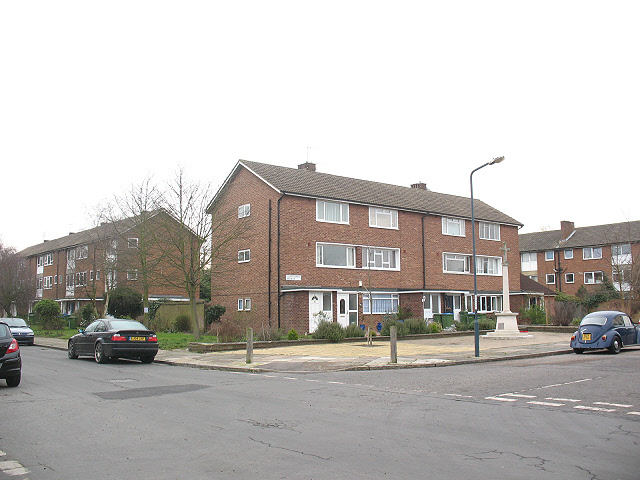
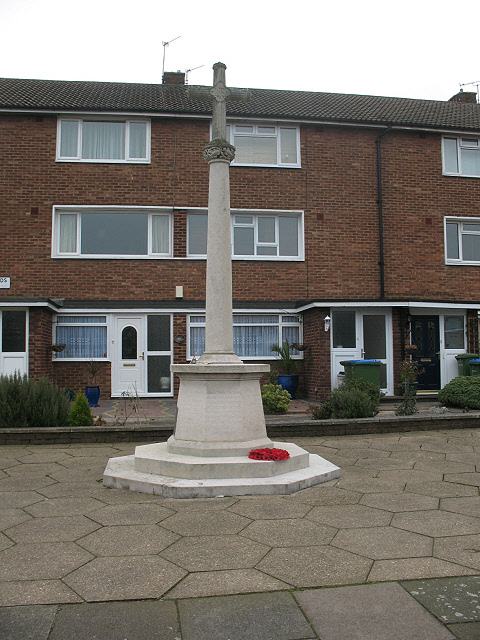
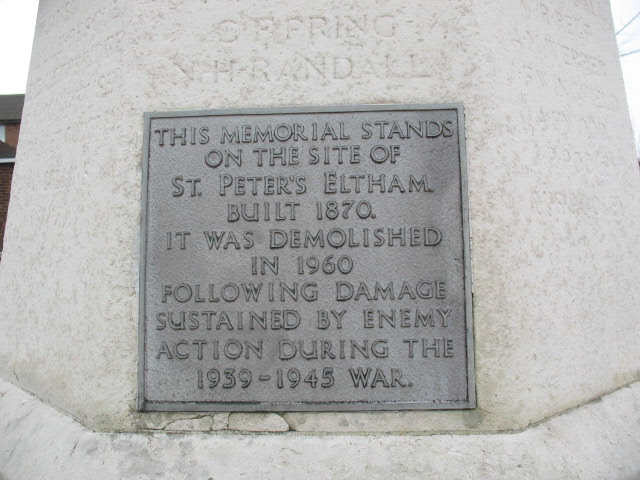
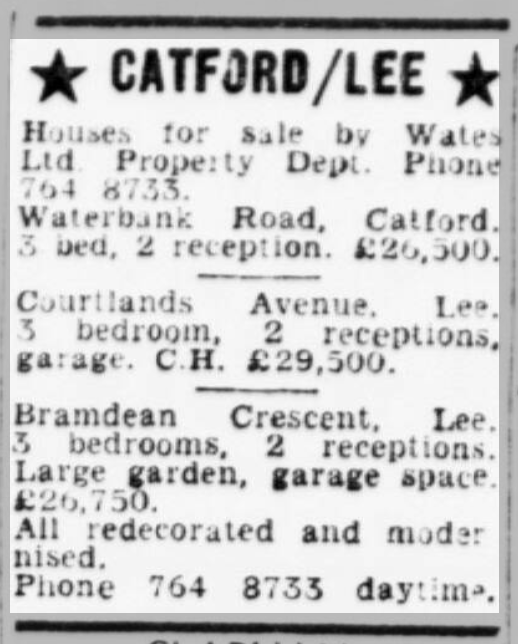
The church was declared redundant in 1960, and along with the rest of the housing on Courtlands Avenue was demolished, probably the same year. The much denser housing, seemingly built by Wates. All that remains now is the war memorial, which has a brief note about the church’s history.
Courtlands Avenue wasn’t the only area of large housing demolished in the early post war period – flats appeared on Ravens Way and opposite on Reed Close – maybe 99 year Crown leases were coming to an end. There was to be much larger scale development redevelopment around Lee Green, again on Crown land.
The new, denser developments with hundreds more homes provided a nascent congregation and the church re-established itself in a wooden hall on the corner of Weigall Road in 1960, joining with the, then recently rebuilt, Church of the Good Shepherd in Handen Road.
The plot on which the hall that the church took over seems to have been undeveloped until the late 1930s when it was listed in Kelly’s Directory as Pyke Jocelyn School of Dancing, it changed hands during the war to become Saville Hall School of Dancing before a 1960 listing as St Peter’s Church.
The wooden structure was replaced by a smaller, attractive multi-purpose building in 1983, presumably at least partially paid for by the sale of part of the site for a sheltered housing development next door.
Notes
Kentish Mercury 15 July 1871
Bedfordshire Times and Independent 16 July 1867
Kentish Mercury 10 December 1870
ibid
Kentish Mercury 10 June 1871
Kentish Mercury 15 July 1871
ibid
Laurence Ward (2015) The London County Council Bomb Damage Maps 1939-1945 p120
Credits
The photographs of the original church are from the collection of Lewisham Archives, remain their copyright and are used with their permission
The photograph of the tin tabernacle on what is now Baring Road was from eBay in September 2016
The Kelly’s Directory data is from a mixture of Lewisham and Southwark Archives
Site of former St Peter’s church, Courtlands Avenue, Lee
St Peter’s parish church, on the corner of Courtlands Avenue (right) and what is now Lyme Farm Road (foreground), was built in 1871. The church was closed in 1939 due to poor attendance. The building survived World War 2, being used for storage, and was not officially redundant until 1960. The site was sold in 1961 to Wates for housing development for £5000: the extent of the church building is represented by the nearest block in this photo and the one to the left of it.
St Peter’s parish war memorial, Courtlands Avenue, Lee
The only evidence left on the ground of St Peter’s church that used to stand on the site of the block of houses in the background is this war memorial. Its octagonal base bears the names – many now illegible – of the men of the parish who fell in World War 1, with a later addition marking World War 2 (but without additional names). See TQ4075 : Plaque on St Peter’s war memorial, Lee for the plaque.
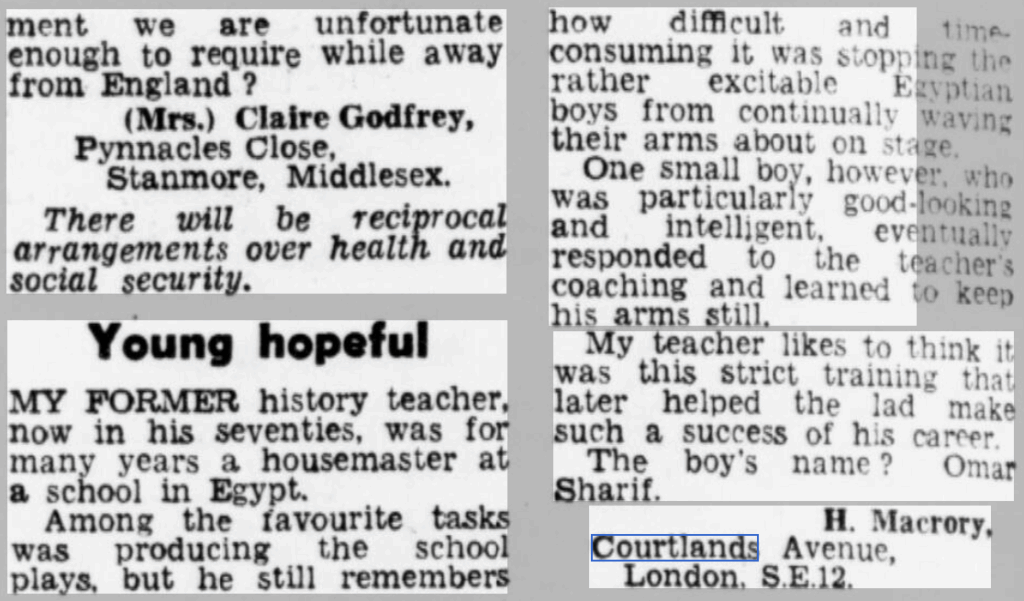
My former history teacher, now in his seventies, was for many years a housemaster at a school in Egypt.
Among the favourite tasks was producing the school play, but he still remembers how difficult and time-consuming it was stopping the rather excitable Egyptian boys from continually waving their arms about on stage.
One small boy, however, who was particularly good-looking and intelligent, evnetually responded to the teacher’s coaching and learend top keep his arms still.
My teacher likes to think it was this strict training that later helped the lad make such a success of his career.